
Deed Types Recorded in Montmorency
Deed research in Montmorency County works best when you know how the indexes are built. The Register of Deeds files every instrument by party name and by legal description, so a productive Montmorency County deed records search follows one parcel through its recorded transfers in order. Along the way you may meet mortgages, releases, plats, easements, and mineral-interest papers. Some of this sits at the counter rather than online. A complete search can span record books, microfiche, and the current imaging system, so plan to search Montmorency County property records by owner name and tract together.
| Deed Type | What It Does | Common Use |
|---|---|---|
| Warranty deed | Conveys the stated interest with deed warranties. | An ordinary arms-length transfer |
| Quitclaim deed | Conveys whatever interest the signer holds, without the same warranties. | Changing or clarifying interests |
| Trustee or representative deed | Conveys through a stated fiduciary capacity. | Trust or estate administration |
| Corrective deed | Corrects an error in an earlier instrument. | Name or description correction |
| Tax-related deed | Records a transfer arising from the tax process. | County public-land or foreclosure trail |
Keep one distinction clear. A mortgage or lien is not a deed. It can encumber the land without moving full ownership. Pull the assignments and releases that follow the first filing, not just the original. A recorded discharge tied to that instrument carries far more weight. An informal paid notation written somewhere else carries less.
Montmorency's Land Records Office
The Montmorency County Register of Deeds serves as the constitutional recording officer for instruments that transfer or encumber land. These cover surface and mineral interests alike. The office sits at 12265 M-32 West, P.O. Box 789, Atlanta, MI 49709. It posts weekday hours of 8:30 a.m. to 4:30 p.m., phone 989-785-8079, and fax 989-785-8080. The office publishes no public web index and lists no earliest online year. Access runs through a call, a mail request, or an office visit. Staff then direct a name or tract search and handle copy requests. The county page links its own recording, copy, and search fee sheets. Ask for current prices before ordering plain or certified copies. The official Register page describes both the office route and its preservation practices.
That official page names the local custodian of the deed records. A quick call settles the current fee and the medium for any year you need.
Trace Montmorency Deeds by Party
The Register keeps alphabetical indexes under every name listed as first or second party. A tract index is also kept, keyed to the legal description. In plain terms, the grantor gave the stated interest and the grantee took it. Search both roles. Then compare descriptions carefully. One person or entity can show up in instruments tied to several different tracts.
- Begin with the current Beacon owner label and full parcel legal description.
- Find that party as grantee on the latest conveyance and note its receipt and recording reference.
- Read the grantor, then search that party as grantee on the earlier acquisition.
- Repeat while matching the tract, name variants, spouses, trusts, estates, and entity suffixes.
- When the index medium changes, ask for the matching deed book or microfiche and keep each reference.
- Grantor
- The party transferring the interest.
- Grantee
- The party receiving the interest.
- Chain of title
- The ordered set of instruments through which the stated land interest moved.
- Book and page
- A volume reference used to retrieve an older recorded item.
- Instrument number
- A unique filing reference used to retrieve a recorded item.
Montmorency Tract Index Cross-Check
A party-name hit only starts the deed search. The tract index is arranged by legal description. It sorts out instruments that belong to land carrying similar names. Bring the subdivision, lot and block. Or bring the section, township, and range text exactly as recorded. For rural property, keep any lake, camp, road, or parent-tract clue handy too. Set each new deed against the description before it. A corrective deed may repair a single word or measurement. A split can leave an older deed describing a parent tract. Beacon shows a child parcel. An easement may touch only a narrow strip. The sequence should account for every change. Two similar street addresses do not always mean the same land.
Images and Microfiche in Montmorency
According to the Register, original instruments are scanned into its imaging system. They are then transferred to permanent off-site microfiche. That workflow does not create a public image portal or an online cutoff date. Ask instead which years sit in deed books, which live on microfiche, and which you can view at the counter. Also ask whether staff can mail a copy. This mixed access defines Montmorency County deed records. A failed web search does not mean the record is missing. It may simply mean the index stays office-held or the image sits on another medium. Give staff a narrow date range, both party roles, and the legal description. That will cut search time.
Online cutoff not published. Official sources do not state the earliest searchable deed year or provide a verified public grantor-grantee portal.
Fire History and Deed Survival
Montmorency County's official history records two severe losses. The old courthouse burned in 1942 and destroyed Prosecuting Attorney records. Surviving county records moved to Community Hall. It burned the next year and destroyed county documents except birth, death, and marriage statistics. The modern Register, though, separately describes scanning and permanent microfiche for land instruments. Those facts call for a record-group question. They do not support a blanket claim that every early deed vanished. Ask whether the specific deed book, plat, tract index, or reception book survives. Ask in what form. The Library of Michigan Montmorency guide offers maps, plat books, newspaper microfilm, and name clues. None of that replaces the recorded instrument. The historic holdings inventory helps frame a precise reference request.
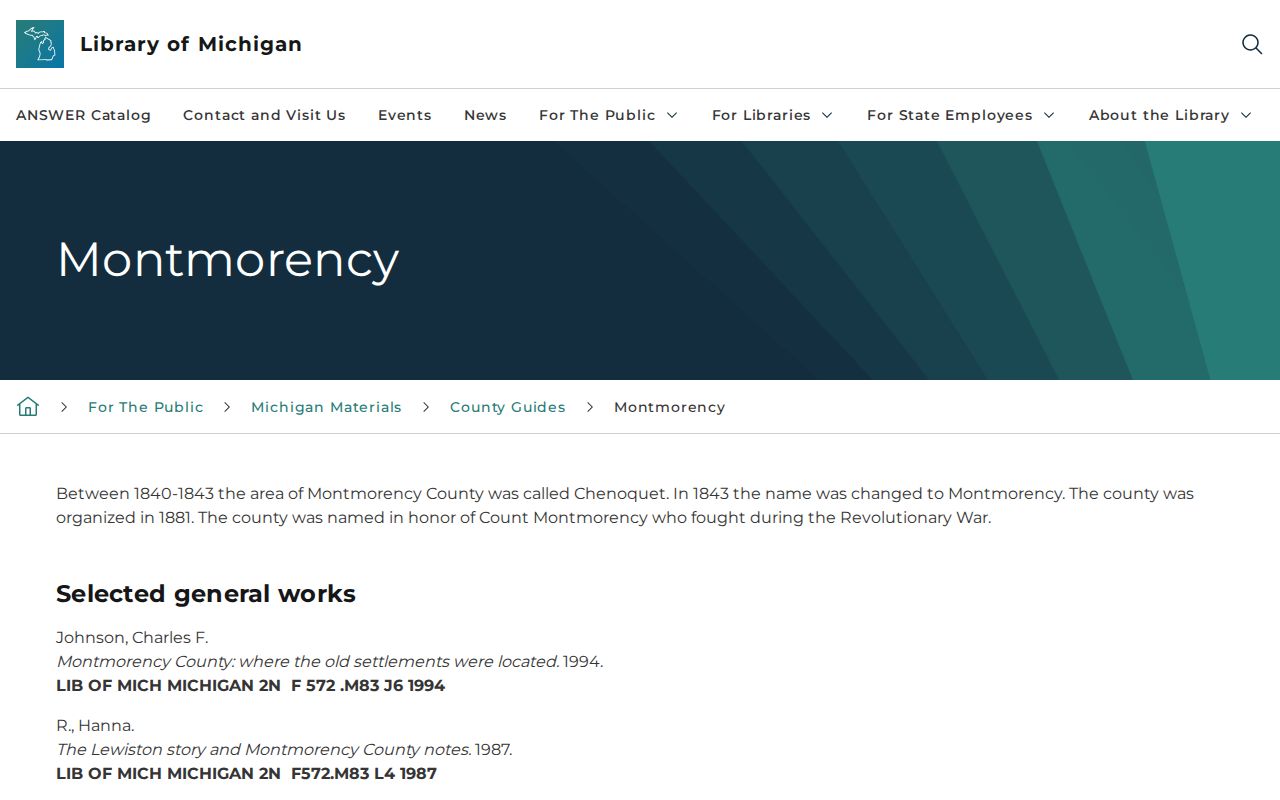
Those listed collections can carry an old surname or place name straight into the Register's surviving name and tract indexes.
Montmorency Plats and Easements
Every plat in Montmorency County lands with the Register of Deeds. The Register also chairs the County Plat Board. A plat fixes the layout of a subdivision. Lots, blocks, streets, and common areas all appear on it. What it cannot do is capture the later history. Deeds, easements, restrictions, and amendments recorded after the plat each leave their own trail. So run a search on the plat name alongside the current legal description before trusting the map alone.
Easements deserve the same care. A right-of-way may burden only a strip of one Montmorency County parcel. It does not have to affect the whole tract. Pull the dominant and servient land, the stated purpose, any width or location detail, the exhibit, and the conditions that end the burden. A GIS line along a road or stream is only a clue. The recorded deed, plat, or easement wording settles the legal question.
Mineral Interests in Montmorency Deeds
Montmorency County is unusual in a helpful way. The Register's custody covers mineral interests as well as surface interests. The county's own forms include a Notice to Maintain Mineral Rights. That matters because a surface deed can look complete. It may reserve minerals, convey only a fraction of them, or point back to an earlier reservation. Follow the chain until that language stops. Never assume the surface owner of record holds everything beneath the ground.
Track every party, fractional interest, legal description, reservation, and later conveyance as you go. When an instrument touches a parent tract, compare its description against later splits of the land. Montmorency County has large forest and working-land tracts. This closer pass through Montmorency County property records is well worth the effort.
Liens Beside Montmorency Deeds
A deed rarely travels alone. Mortgages, assignments, releases, construction liens, restrictions, lis pendens, and recorded court orders can all sit beside it in the land trail. So build a dated sequence from the start. Begin with the deed that put the party in title. Then list each encumbrance and its later release or order. Match the instrument number and legal description at every step.
A court docket may surface a quiet-title case or judgment. But MiCOURT says plainly that its online information is not the official file. Get the dispositive order from the proper court. Then check whether it was recorded. A UCC filing works only as a cross-check. It covers a named business debtor and its collateral. It does not automatically prove a fee-simple lien on Montmorency County land.
Note: An absent name hit is inconclusive until the office confirms spelling, party role, date range, and record medium.
Order a Montmorency Deed Copy
Call the Register before placing any order. Have the grantor and grantee names ready. Add the legal description and an approximate recording date. Include any book/page or instrument number you hold. Ask whether the image can be inspected in person. Ask whether a staff search is required. Ask which delivery routes exist, and whether your use calls for a plain or certified copy. The local fee sheet controls on cost.
A certified copy carries the custodian's certification. That formality matters whenever proof of the public record is the point. For preliminary research, a plain copy of a Montmorency County deed often suffices. Keep the receipt, retrieval date, and certification status with the image. That way the source stays clear.
Recorded, not guaranteed. Montmorency County deed records show filed instruments. They do not rule out unrecorded claims or supply a title opinion.